
Keywords
child and youth care
3D printing
service-learning
adaptive technology
How to Cite




Abstract
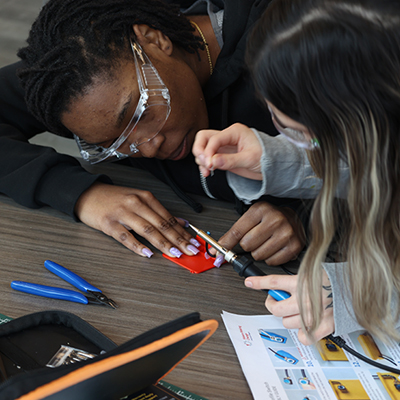
My Teaching Excellence Program (TEP) professional learning project explored how a service-learning initiative leveraging Humber’s Idea Lab could enhance student learning objectives in the Child and Youth Care (CYC) diploma program. An existing assignment in a Therapeutic Activities Programming course was revised to include an opportunity for students to create assistive devices. Students participated in two workshops where they learned how to 3D print adaptive switch components and assemble them using basic soldering. Students then applied these skills to build switches and adapt battery-operated toys for clients with physical and cognitive disabilities. At the end of the project, the adapted toys were donated to a local pre-school serving children with special needs. To assess the impact of this experience, pre- and post-activity reflection questions were planned to measure changes in students’ attitudes, beliefs, and confidence using maker technologies in their CYC practice; however, low participation in the evaluation components prevented meaningful analysis. Despite this result, the project demonstrated the potential of maker‑based service-learning to build students’ confidence with maker and digital technologies and to increase their awareness of DIY assistive technology solutions relevant to their practice.
Note:
This article is part of a series derived from Humber Polytechnic's Teaching Excellence Program (TEP). Recent graduates of the program were invited to select and submit work from their time in the program to JIPE. These reflective works offer an engaging glimpse into faculty perspectives, their approaches to teaching and learning, and their experiences as educators.
References
Benham, S., & San, S. (2020). Student technology acceptance of 3D Printing in occupational therapy education. American Journal of Occupational Therapy. 74 (3). 7403205060-7403205060p7. https://doi.org/10.5014/ajot.2020.035402
Jacoby, B. (2014). Introduction to service learning. InService-Learning Essentials. John Wiley & Sons, Incorporated.
Kellam, S. M., Boleneus, G. J., Stewart, J., Richter, D. C., Michaelis, B. M., & Gerlick, R. E. (2019, June). An undergraduate engineering service learning project involving 3D-printed prosthetic hands for children [Paper Presentation]. 2019 ASEE Annual Conference & Exposition, Tampa, Florida. https://peer.asee.org/32085
Pearson, H. A., & Dubé, A. K. (2022). 3D printing as an educational technology: theoretical perspectives, learning outcomes, and recommendations for practice. Education and Information Technologies, 27(3), 3037–3064. https://doi.org/10.1007/s10639-021-10733-7

This work is licensed under a Creative Commons Attribution-NonCommercial-NoDerivatives 4.0 International License.
Copyright (c) 2026 Erin Walker