
Keywords
food justice
social justice
narrative-based research
cultural identity
belonging
Ontario colleges
How to Cite




Abstract
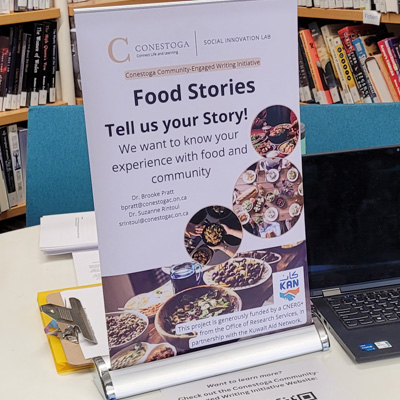
This article explores how narrative inquiry, as a research method, can elicit rich qualitative data that contributes in significant ways to understanding feelings of belonging among post-secondary international students. More specifically, the article describes a 2025 mixed-methods study (funded by an internal grant) on the relationship between food, identity, and community for international students enrolled at Conestoga College, not to analyze the findings of that publication, but rather the narrative-based aspects of its methodology. The study included community consultations, a student survey (N = 332), and a series of writing events during which researchers solicited student narratives (N = 164). Research was conducted in the context of unprecedented internationalization at the college that resulted in a substantial population of students at an elevated risk of food insecurity and its concomitant problems. The narrative inquiry component of the study demonstrated that food plays an important role in the lives of Conestoga’s international students as a representation of cultural heritage, a connection to family, and a potential pathway to community belonging. Here, we discuss how inviting students to share stories about their own experiences via narrative inquiry is a research approach that not only resulted in a more thorough understanding of their concerns than traditional research methods typically allow, but also one that expressed to students the value of their voices. This article highlights the benefits and reflects on the inherent challenges of narrative inquiry as a meaningful avenue for pursuing social justice research, using our 2025 project as a case study.
References
Bailey, A. (2017). The migrant suitcase: Food, belonging and commensality among Indian migrants in The Netherlands. Appetite, 110, 51–60. https://doi.org/10.1016/j.appet.2016.12.013
Barkhuizen, G., & Consoli, S. (2021). Pushing the edge in narrative inquiry. System, 102, 1–9. https://doi.org/10.1016/j.system.2021.102656
Bochner, A.P., & Riggs, N. A. (2014). Practicing narrative inquiry. In Leavy, P. (Ed.), The oxford handbook of qualitative research (pp. 195-222). Oxford UP. https://doi.org/10.1093/oxfordhb/9780199811755.013.024
Bruening, M., Argo, K., Payne-Sturges, D., & Laska, M. N. (2017). The struggle is real: A systematic review of food insecurity on postsecondary education campuses. Journal of the Academy of Nutrition and Dietetics, 117(11), 1767–91. https://doi.org/10.1016/j.jand.2017.05.022
Butina, M. (2015). A narrative approach to qualitative inquiry. Clinical Laboratory Science: Journal of the American Society for Medical Technology, 28(3), 190–96. https://clsjournal.ascls.org/content/ascls/28/3/190.full.pdf
Conestoga Institutional Research. (2025, March 3). PSE – Demographic details. Institutional Research. https://www.conestogac.on.ca/about/corporate-information/institutional-research
Conestoga Students Inc. (2023). Food security report. https://www.conestogastudents.com/pageassets/representation/advocacy/2023-Food-Security-Report-Final.pdf
Corkum, A. (2020). Household food insecurity in Canada before and during the COVID-19 pandemic: findings from the International Food Policy Study 2018-2020. University of Waterloo. https://uwspace.uwaterloo.ca/bitstream/handle/10012/18272/Corkum_Adele.pdf?sequence=5
Dixon, B. A. (2019). Food justice and narrative ethics: Reading stories for ethical awareness and activism. Bloomsbury Publishing. https://doi.org/10.5040/9781350054578
Entz, M., Slater, J., & Desmarais, A. A. (2017). Student food insecurity at the University of Manitoba. Canadian Food Studies, 4(1),139–59. https://doi.org/10.15353/cfs-rcea.v4i1.204
Farahbakhsh, J., Hanbazaza, M., Ball, G. D. C., Farmer, A. P., Maximova, K., & Willows, N. D. (2017). Food insecure student clients of a university-based food bank have compromised health, dietary intake and academic quality. Nutrition and Dietetics, 74(1), 67–73. https://doi.org/10.1111/1747-0080.12307
Ghosh, S., Kim, P. M., Garrison, R. M., & Shahidnia, S. (2022). Multiple food vulnerabilities of international students from India in Greater Toronto Area colleges: A pilot study. Canadian Geographer, 66(3), 569–80. https://doi.org/10.1111/cag.12757
Goldrick-Rab, S., Richardson, J., Schneider, J., Hernandez, A., & Cady, C. (2018). Still hungry and homeless in college. Wisconsin HOPE Lab. https://eric.ed.gov/?id=ED610982
Hattangadi, N., Vogel, E., Carroll, L. J., & Côté, P. (2019). “Everybody I know is always hungry… but nobody asks why”: University students, food insecurity and mental health. Sustainability, 11(6), 1571. https://doi.org/10.3390/su11061571
Immigration, Refugees and Citizenship Canada. (2024, June 27). CIMM - Conestoga College: Key Facts and Figures. https://www.canada.ca/en/immigration-refugees-citizenship/corporate/transparency/committees/cimm-feb-28-2024/conestoga-college.html
Johnston, O., Wildy, H., & Shand, J. (2023). Student voices that resonate – Constructing composite narratives that represent students’ classroom experience. Qualitative Research, 23(1), 108–24. https://doi.org/10.1177/14687941211016158
Jones, N. N. (2016). The technical communicator as advocate: Integrating a social justice approach in technical communication. Journal of Technical Writing and Communication, 46(3), 342–61. https://doi.org/10.1177/0047281616639472
Kim, J.H. (2016). Understanding narrative inquiry: The crafting and analysis of stories as research. SAGE. https://doi.org/10.4135/9781071802861
Krieswirth, M. (1992). Trusting the Tale: The Narrativist Turn in the Human Sciences. New Literary History, 23, 629-657. https://doi.org/10.2307/469223
Kwon, E. (2023). Considering the role of integration experiences in shaping immigrants’ post‐migration food choices and eating practices. The Canadian Review of Sociology, 60(4), 741–62. https://doi.org/10.1111/cars.12456
Lee, J.S., Gundersen, C., Cook, J., Laraia, B., & Johnson, M.A. (2012). Food insecurity and health across the lifespan. Advances in Nutrition, 3(5), 744–45. https://doi.org/10.3945/an.112.002543
Long, L.M. (2017). Meaning-centred research in food studies. In J. Chrzan & J. Brett (Eds.), Food culture: Anthropology, linguistics and food studies (pp. 143-51). Berghahn Books. https://doi.org/10.1515/9781785332906
Lordly, D., Guy., J., & Li, Y. (2020). Increasing awareness: Cultural food experiences of international students in Canada. In V. Tavares (Ed.), Multidisciplinary perspectives on international student experience in Canadian higher education (pp. 21-40). IGI Global. https://doi.org/10.4018/978-1-7998-5030-4.ch005
Maroto, M. E., Snelling, A., & Linck, H. (2015). Food insecurity among community college students: Prevalence and association with grade point average. Community College Journal of Research and Practice, 39(6), 515–26. https://doi.org/10.1080/10668926.2013.850758
Men, F., Elgar, F. J., & Tarasuk, V. (2021). Food insecurity is associated with mental health problems among Canadian youth. Journal of Epidemiology and Community Health, 75(8), 741–748. https://doi.org/10.1136/jech-2020-216149
O’Kane, G., & Pamphilon, B. (2016). The importance of stories in understanding people’s relationship to food: narrative inquiry methodology has much to offer the public health nutrition researcher and practitioner. Public Health Nutrition, 19(4), 585–92. https://doi.org/10.1017/s1368980015002025
Olauson, C., Engler-Stringer R., Vatanparast H., & Hanoski R. (2018). Student food insecurity: examining barriers to higher education at the University of Saskatchewan. Journal of Hunger & Environmental Nutrition, 13(1), 19–27. https://doi.org/10.1080/19320248.2017.1393365
Phillips, E., McDaniel, A., & Croft, A. (2018). Food insecurity and academic disruption among college students. Journal of Student Affairs Research and Practice, 55(4), 353–72. https://doi.org/10.1080/19496591.2018.1470003
Pilli, B., & Slater, J. (2021). Food experiences and dietary patterns of international students at a Canadian university. Canadian Journal of Dietetic Practice and Research, 82(3), 100–106. https://doi.org/10.3148/cjdpr-2021-006
Pino Gavidia, L. A., & Adu, J. (2022). Critical narrative inquiry: An examination of a methodological approach. International Journal of Qualitative Methods, 21, 1–5. https://doi.org/10.1177/16094069221081594
Pratt, B., & Rintoul, S. (2025). Food stories: A narrative-based approach to analyzing international students, food, and community. Conestoga Social Innovation Lab. https://research.conestogac.on.ca/research-publications/publications/food-stories-a-narrative-based-approach-to-analyzing-international-students-food-and-community
Sarbin, T. (Ed.). (1986). Narrative psychology: The storied nature of human conduct. New York: Praeger.
Schermuly, A. C., & Forbes-Mewett, H. (2016). Food, identity and belonging: a case study of South African-Australians. British Food Journal (1966), 118(10), 2434–43. https://doi.org/10.1108/BFJ-01-2016-0037
Smith, E. B., & Luke, M. M. (2023). Re-engaging tensions within narrative threads: Ethical obligations, researcher identity, and methodological meaning making. Journal of Constructivist Psychology, 36(4), 458–66. https://doi.org/10.1080/10720537.2023.2170502
Spence, D. (1982). Narrative truth and historical truth: Meaning and interpretation in psychoanalysis. New York: W. W. Norton. https://archive.org/details/narrativetruthhi0000spen
Squire, C., Andrews, M., Davis, M., Esin, C., Harrison, B., Hyden, L., & Hydén, M. (2015). What is narrative research?. Bloomsbury. http://dx.doi.org/10.5040/9781472545220
Wood, J. L., & Harris, F. (2018). Experiences with “acute” food insecurity among college students. Educational Researcher, 47(2), 142-45. https://doi.org/10.3102/0013189X17752928
Wright, K. E., Lucero, J. E., Ferguson, J. K., Granner, M. L., Devereux, P. G., Pearson, J. L., & Crosbie, E. (2021). The influence of cultural food security on cultural identity and well-being: a qualitative comparison between second-generation American and international students in the United States. Ecology of Food and Nutrition, 60(6), 636–62. https://doi.org/10.1080/03670244.2021.1875455

This work is licensed under a Creative Commons Attribution-NonCommercial-NoDerivatives 4.0 International License.
Copyright (c) 2026 Brooke Pratt, Suzanne Rintoul